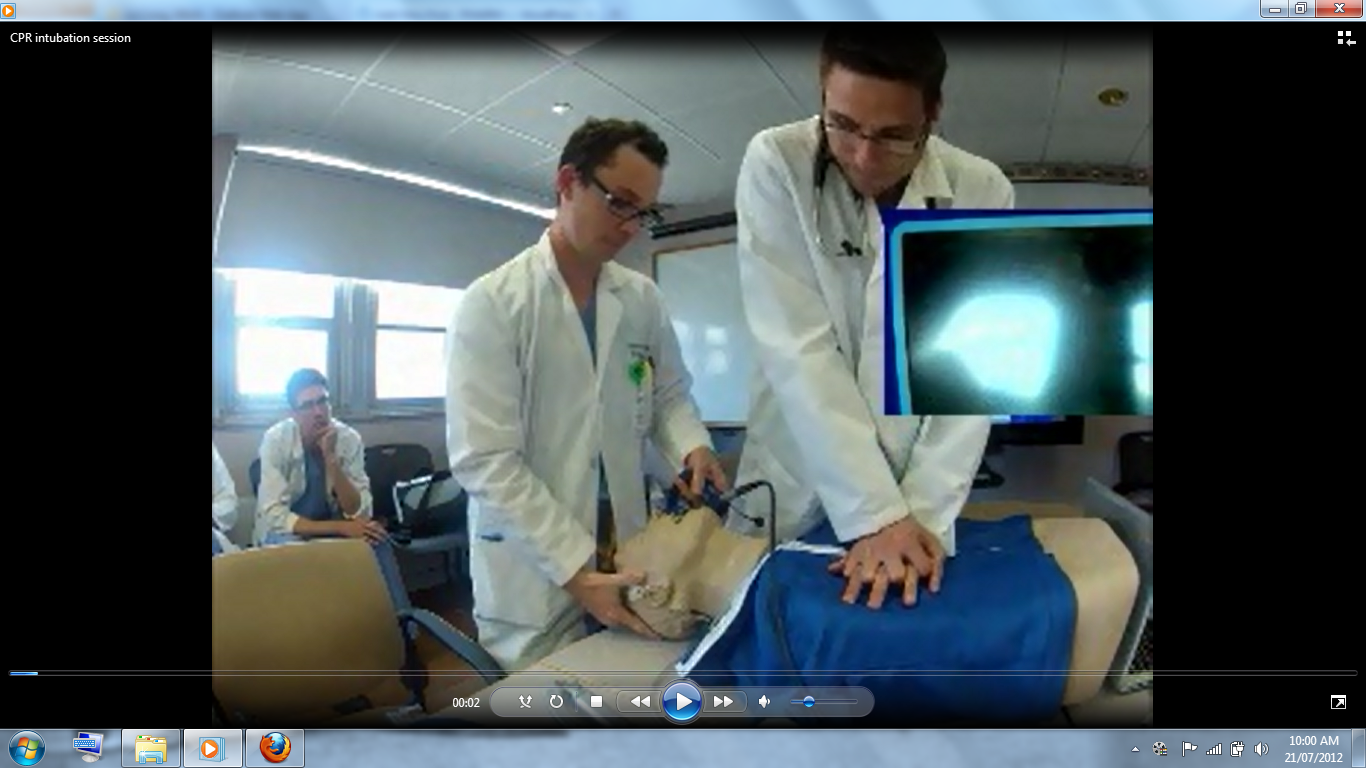
First for background, here is a few minutes of reading from a Twitter debate
[View the story “Should medical students learn intubation ? ” on Storify]
Prehospital and Retrieval Medicine – THE PHARM dedicated to the memory of Dr John Hinds
In memory of Dr John Hinds
First for background, here is a few minutes of reading from a Twitter debate
[View the story “Should medical students learn intubation ? ” on Storify]
Comments are closed.
 Prehospital and Retrieval Medicine - THE PHARM dedicated to the memory of Dr John Hinds
I think Nick Chrimes has said it all
“Why teach them a complex skill, performed under stress, that they rarely get to practice & has potential to kill?”
I do agree with teaching airway management – and as part of that they may have a few minutes on a mannikin to see that intubation is not the simple procedure that they think it is
I don;t let them intubate in OT – there is no point.
I WILL teach competent BMV, LMA and decison-making
In an ideal world, would embed THE VORTEX in medical school/JMO years, accepting that the technical skill of ETT is not needed – but the 3 pillars of airway management are key
…as for delivery? Look, a taxi driver can do it. Doesn;t need a medical degree!
From across the pond (and more pond, and even more pond) in the USA, if our EMT-Intermediates who have only 2 semesters of school can intubate…seems silly we wouldn’t teach medical students who are receiving 4 years of school.
…Except I don’t really think our Intermediates (now AEMTs) should intubate, and the number of paramedics who need to be intubating should also shrink. Having witnessed providers of all levels (including MDs) attempt intubation out-of-hospital, I believe Nick is 100% correct: if you do not intubate for a living, you should not attempt it.
What they really need to be learning is a team-focused airway management system. We’re starting down the path of adopting something like The Vortex at our fire department. In the last 2-3 years it has sunk in–across all of our providers–that an ETT as a means to an end rather than The One True Procedure(tm).
The baby delivery seems out of place when thrown in with intubation, but my feelings echo those of Tim’s: teach them how to coach a cop or a bystander through it.
i would add the above to nursing students too.. i believe the essential strategies for lifesaaving purpose are bvm and survival cric. i consider them as important as using an aed, doing cardiac compressions.
it is important that nursing students should be taught airway mgt beacuse there are going to care for pts with airway problems, have to cope with airway emergencies both in an assistive and independent role.final;ly nurses are the one that are continously with pts.
If intubation is a team approach one cannot start by being a leader from the start.but being a follower therfore as medical/nursing student level they should be taught the assissitve nature of intubation. .
by time they can move up the ladder and eventually become airway leaders
The recent incarnations of airway algorithms (such as the Vortex and the AirwayHenge) are ventilation centered. If we move forward with a ventilation centered paradigm, the junior trainees will likely not get past facemask and supraglottic airway ventilation. The challenge to us as trainers is to give our students to the time to learn and use these skills (You must allow the the student to apply the teaching in a safe circumstance without constant suggestion or interruption). All too often, at least in the US medical system, we all want to move too quickly through the ventilation part and get right to the intubation part. This is largely about appearances–we want to appear confident, competent, and swift so as to gain the approval of others who are “waiting” until the patient is intubated to perform other tasks, such as patient positioning and skin prep in surgery. If you are not careful, the nurses will prep your hands into the surgical field in some operating rooms if you don’t tape the tracheal tube fast enough!
It is true that the learning process appears as if the student is struggling. It takes an instructor with a colossal amount of experience and patience to teach these skills–they have to know (constantly) what the state of the patient is at all times, and allow the student to apply the ideas and skills you have taught them. The student must know when to ask for help or assistance–this is a matter of trust between the student and the instructor. If there is a lack of trust (the student is deficient or the instructor is too harsh), this isn’t going to happen.
So, let me wrap this comment up with something that I hope will be helpful, because it is what has proven true in my practice.
Let’s envision the fruit of our FOAM sharing here–the new paradigms are ventilation centered. Cool. Now how does that work out in practice and teaching moment-to-moment during direct patient care? The answer is end-tidal CO2 monitoring. Your ventilation centered airway management curriculum is based on the students’ understanding that they must demonstrate understanding and competency by generating an end-tidal CO2 number and good waveform on the monitor. Does this apply only to the OR? It might for most, but I am going to argue that waveform capnography is a mandatory technology in this second decade of the 21st century, just like a defib unit. The AHA now basically commands its use during ACLS. Until you actually see ROSC demonstrated on an EtCO2 device, you may not be a believer. I have seen it, I am now a believer.
So the students get taught waveform capnography alongside the vital skill of facemask and SGA ventilation. It makes total sense–it’s instant feedback. Once the student gains the understanding and ability of being able to mask ventilate to produce a reasonable waveform signal, now they have a second piece of information: A global assessment of cardiopulmonary function and the near-ness to complete arrest based on the number and the waveform. If the waveform isn’t good, they know not to trust the number. If the waveform is good (and the number is bad), they know to start the pressors/fluid resuscitation/place the chest tube/pericardial window/cross clamp the aorta, etc… OK, I’m going a bit too far here, but I hope you understand my points.
Thanks!
Amen. I’m fortunate to work in a State full of EtCO2 believers.
I’m fairly certain waveform capnography will be mandatory for any EMS service in NC which intubates by our next protocol revision (2015 or sooner; you can’t RSI without it anymore). Since 2009 it has been strongly recommended and also has been extended down to our BLS providers for use with SGA’s.
We’ve found it to be a game changer in our practice, especially in cardiac arrest.
Oh, and one more thing…the current technology in bedside ventilation is a bad choice for beginners. The Oxylator will be available in Australia by next year. It is a game changer, like seat belts in an automobile. Once you learn it, you’ll start basing your airway management tasks around its operation.