

Scott Weingart calls it The Mind of a Resuscitationist – Logistics vs Strategy
Cliff Reid writes about Making things happen
I say it is the First Rule of PHARM ( Prehospital and Retrieval Medicine) = KNOW YOUR GEAR

RSI kit dump sheet courtesy of NSW AMbulance and Dr Cliff Reid
Put simply, what you take with you is all you got, so know what it is and how to use it.
Its like camping except now and then you have to keep someone alive and even keep yourself alive at times.
But you could apply this in really any emergency medicine or critical care job, to be frank.
AIRWAY GEAR : No excuses here. What gets handed to you or you pull out of that kit bag, you should know how to trouble shoot it in case it does not work. Do you know what light source your laryngoscope uses? What power source it needs? How bright is the light on that laryngoscope? How often do you check it?
Levitan taught me that often larygnscope lights are not bright enough simply because people do not check them and let the bulb and/or battery to wear out.

Every shift you walk into , do you check that light? Or leave it for someone else to? If you are going to use it, might be worth checking it..EVERY SHIFT YOU WALK INTO.
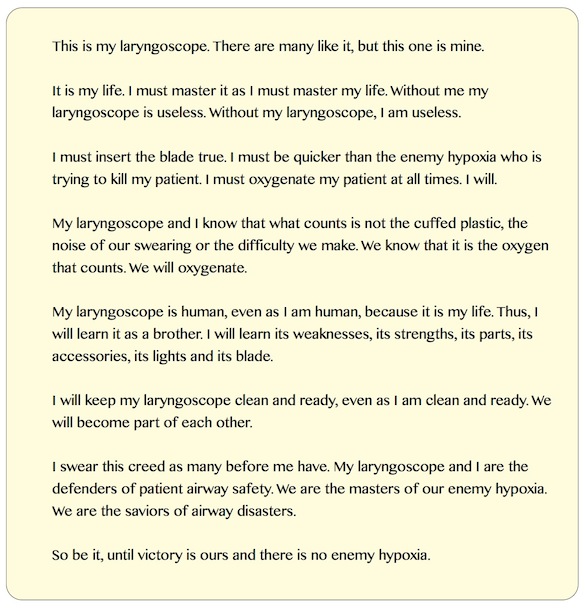
I wrote the following adaptation of the famous Marine Corps Rifleman’s creed, called the Intubator’s Creed (thank you to Cliff Reid for posting this on his website and formatting it):
The humble bougie. Which type do you have? Does it keep its stored shape or can you mold it into shape? Have you rehearsed with your crew how you are going to use it during an intubation or for a scalpel bougie cricothyroidotomy?
The supraglottic airway device in your work area, what is it and does it need air to inflate and if so how much? Do you measure the inflation pressure of your SGA? If it does not adequately ventilate, what is your backup plan?
BREATHING GEAR : The plain old bag/valve mask resuscitator.Does it provide PEEP? If not, how can you make it provide PEEP? Have you practised with it with one hand, two hands , four hands? Have you tried to use the ventilator to provide mask ventilation as per Scott Weingart? DO you know what ventilator you have available? How to turn it on? Set it up? Do you know how to check the plateau pressure and flow curves?

Can you start CPAP or BiPAP mask ventilation by yourself if you needed to?
CIRCULATION GEAR : Do you have a fancy IO device or not? Do you know how to use it on kids and adults? Do you have access to portable USS for vascular access? Are you able to mix your own push dose pressors and infusions? Are you familiar with your infusion pumps and know how to set them up?

KNOW YOUR GEAR
There are no excuses. This is the first rule of PHARM.
 Prehospital and Retrieval Medicine - THE PHARM dedicated to the memory of Dr John Hinds
Thank you for an excellent post! Checking your gear and knowing its weaknesses and strengths is important to everyone, but of course becomes more important in the prehsopital environment where there is no backup. I miss one important piece of equipment in this post – suction; electrical, venturi or mechanical; have it, know it and check it!
Maybe our most important equipment is the bag/valve mask resuscitator. How do you folks check it? Many years I just checked that it could be compressed and that I couldn’t compress when I occluded. Then I learnt that there actually is EIGHTdifferent things you have to check to be sure a plain old Laerdal resuscitator works properly… And this maybe the most important gear, if everything else fails, I’ve never checked properly, but taken for granted that the assistants had assembled correctly… It’s a bit easier with single-use resuscitators, but they also need to be checked! It’s worth spending 45-60 seconds doing a proper check!
Spot on
These posts and others (particularly the logistics vs strategy etc) have made me really think more about my resus room and OT environment
Put simply, can I troubleshoot on my own, or can things be made to work with just the locum doctor and an agency nurse?
Become a big fan of checklists, of laminated cards as ‘aides memoire’ and of practicing scenario-nbased trianing whenever there is a chance
For us, complacency is the killer. In a small rural Australian hospital, true ‘bicycle clip’ emergencies are few-and-far between…so people don;t bother “It’ll never happen to me” or “We don;t need to know how to set up the oxylog, cos we never need it” Couple this with induction for new staff that famously included “There’s the defib…don;t ask me how to use it” from a former CNC…
Mostly things will go fine. But when the shit is hitting the fan, and I am taskloaded..I want to be able to off load tasks and make things as easy as possible
Thanks Minh, Cliff, Casey and Scott for these great blogs. It’s making MY practice better
I think.
Hmmm….just preparing some new recruits for 2015 with a version of “the intubators creed”
https://vimeo.com/115406193