
Ok so I have been at Greater Sydney Area HEMS induction training this week.
On the first day Dr Karel Habig, the medical director of the service, said those words of the title “Prehospital and Retrieval Medicine (PHARM) is the finishing school for critical care”
This one sentence encapsulated the whole ethos and culture of this elite unit and it shows in how seriously they take their training, in particular the induction course.
It is run to military planning and timing with a large group ( 24 this time). If anyone has run medical education/training courses, you will appreciate the logistical and educational challenges involved!
You might wonder why did I go, since I run aeromedical courses and do training all the time in my service? Obviously through FOAMEd I have a social network with some of the staff at GSA HEMS. They have been at the two SMACC conferences and we share a lot of common interests. But it was more than just an opportunity to catch up with old friends.
I truly wanted to see how they did their training. See, like how Victorial Brazil talked about at SMACCGOLD on medical tribalism, the faculty at GSA HEMS every time they have to run induction training for new doctors, they have to deal with people from all the different medical tribes and not only medical but they have to train paramedics as well to work together as a prehospital team with the new doctors. Its a tough challenge to get it right and I wanted to observe how they did it.
So after 4 days of observing and taking notes and media recordings, here are my thoughts:
- Instill a team spirit early – it was clear from Day 1 of induction what the faculty expected and the objective of team building was spelt out from the start. Everyone was expected to come in ambulance issue uniform and stay for the designated hours. They were long 10 hr days of training but because the faculty laid down the expectation, it really built a sense of group achievement and goal setting.
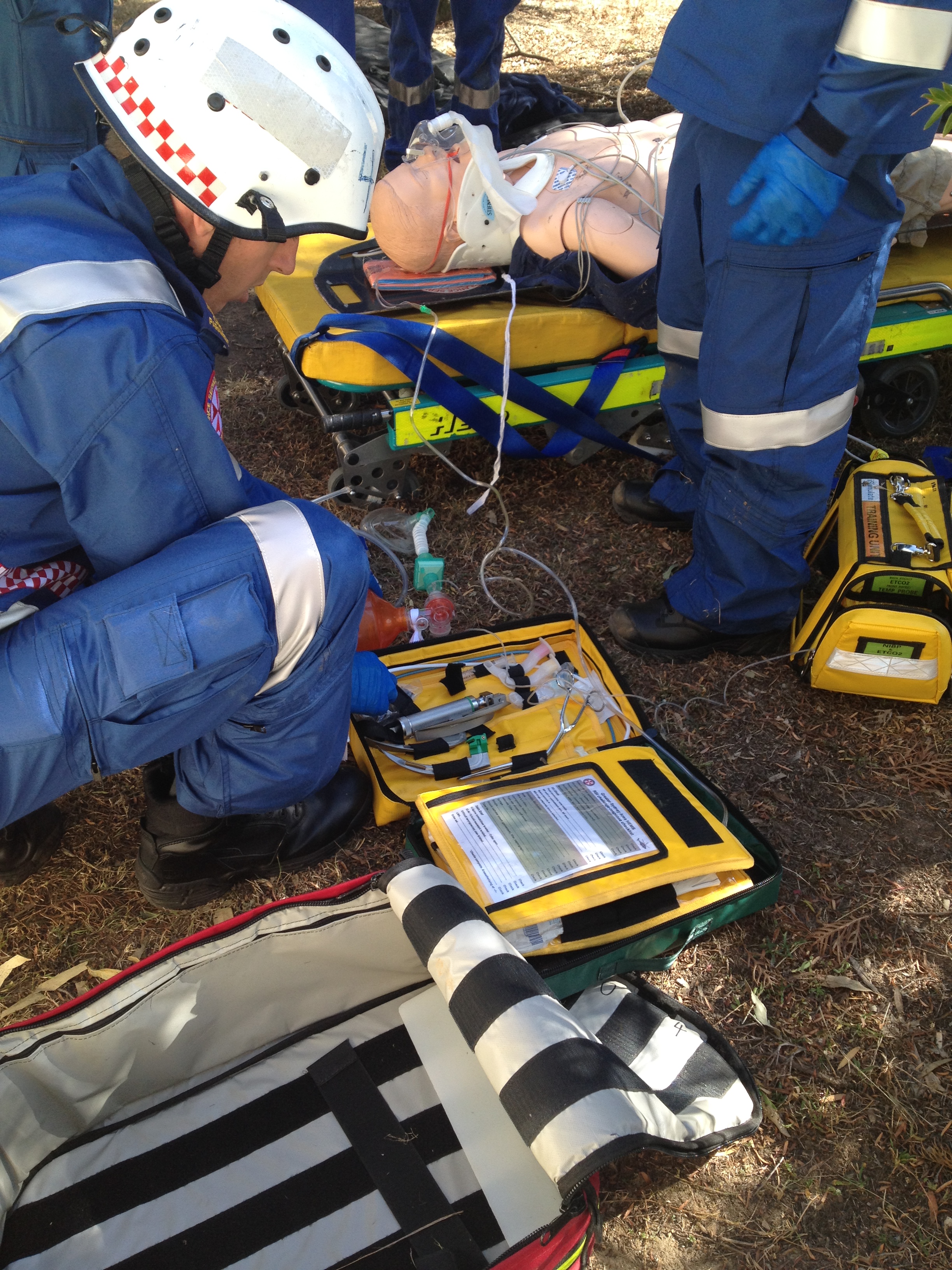
- Train a standard and train it hard – GSA HEMS are really good at this. Taking different views on doing the same thing and cutting through the tribalism and teaching ” There are many ways to do this, but this is the GSAHEMS way and we want you to do it that way!” Whilst this sounds dogmatic, in fact it works well for group psychology. It offers the reassurance and protection of the group approach and brings everyone onto the same level. The consultants of the service teach the standard and say thats what they would do, so the new doctors and paramedics see the power of having a well thought out but simple approach that is done the same way each time. This is so evident in how they teach their RSI approach- it has become almost ritualised. Everyone uses the checklist, same kit bag. Direct laryngoscopy is the standard approach with a bougie.
3. Motivated faculty helps..a lot! – I was an ATLS/EMST instructor for 7 years as well as a RFDS aeromedical educator running courses for 5 years. I have post graduate certificate in training/adult education. I have worked with many instructors/educators. GSA HEMS have some of the best I have ever seen in the field of prehospital and critical care. What sets them apart? Enthusiasm! I met most of the faculty 4 years ago at an aeromedical conference in UK and they were just as enthusiastic about their jobs as they are now! They love to impart their knowledge, wisdom and experience of the craft of prehospital & retrieval medicine. Since 2010, their ranks have been expanded with new instructors who are even more motivated and passionate! This is a hallmark sign of an elite unit. Trainees graduate and return to become trainers.
Dr Brian Burns ,a great faculty member, demonstrates his enthusiasm for training in this simulated agitated patient scenario!
Clearly the faculty are well led by Cliff Reid. There were daily faculty meetings to debrief the day’s proceedings and to find ways to improve for next time. These were as enthusiastic as at start of day training! I never witnessed this during my 7 years on ATLS/EMST faculty! Usually by end of the day, all the faculty were so worn out, the debrief was painfully woeful and tedious. GSAHEMS end of day training faculty meetings were actually fun!
Cliff puts a lot of thought into his education and it goes beyond medicine. At the end of one day this week, at the start of the faculty debrief he played this video …
Ok its no secret Cliff and I are big Bruce Lee fans..and it might seem irrelevant for some of the new folks who may have never seen or heard about Bruce Lee.
The music video is a montage of footage from some of his most famous movies as well as a special Canadian interview he did in which he explained a lot of his teaching philosophies..hence the line “Be like water”
And so this finally ties in with my interest in medical tribes and how we train the many tribes to work effectively in prehospital and retrieval medicine. Cliff said it so well when after the video, he thanked the faculty for “being like water” and remaining adaptable to the varying personalities and tribal cultures of the trainees.
Next blog, lets go through the GSAHEMS approach to prehospital airway..
to be continued!
 Prehospital and Retrieval Medicine - THE PHARM dedicated to the memory of Dr John Hinds
…have they convinced you to use a checklist yet mate?