
Clearly beyond Retrieval
In memory of Dr John Hinds

This is the first of what we hope will be a series of posts from Dr Paul Bailey who works as a Medical Director for CareFlight International Air Ambulance. Paul will try to provide insights into the challenges of managing retrievals across oceans. Here’s the starter.
In his real life, Paul Bailey is an Emergency Physician based in Perth, Western Australia who dabbles in the Greyhound racing industry (having owned 10 dogs and never been to the track). He can often be found in the outer at an Aussie Rules football oval, most commonly critiquing the performance of the umpires in an entirely constructive manner. Past lives include a molecular biology PhD – in Jellyfish venom – don’t ask – and being a glassy in various drinking establishments in Western Australia.
Paul has previously undertaken international retrievals, helicopter work supporting Australian Army exercises and time with Queensland Rescue at…
View original post 1,150 more words


Continue reading “The Airway Meeting 2014 presentation slides”
There’s been a lot of stimulating discussion after parts 1 and 2 of this series from Dr Alan Garner (you can check those here and here). Here’s part 3.
Thanks for sticking with the discussion so far. In part 2 we had a look at AP compression injuries and lateral compression injuries. Short summary is binders make sense and there is some observational evidence of benefit in AP compression injuries. However in lateral compression, binders make no biomechanical sense and there is definite evidence they increase fracture displacement both in cadavers and real live trauma patients.
The final group that we have not yet considered in the Young and Burgess classification is the vertical shear group. These patients are complex because the injuries are both horizontally and vertically unstable. You will see what I mean if you have a look at this Xray:
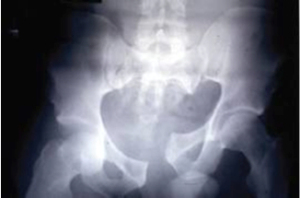
Is putting a binder around the…
View original post 1,253 more words
EDIBLE CRICOTHYROTOMY MODEL from Rob Bryant on Vimeo.
The fluids of choice in prehospital field are, in most cases, cristalloids (Norma Saline or Lactate Ringer).
But what is the physiological impact of saline solutions when administered in large amounts (as the latest ATLS guidelines indicates) to hypotensive trauma patients?
Is aggressive Fluid resuscitation the right strategy to be pursued?
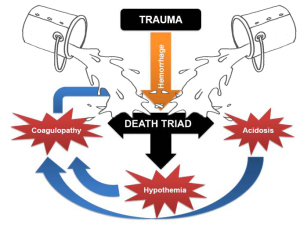
The triad of post-trauma lethal evolution is:
Aggressive fluid resuscitation with cristalloids, and saline solutions in particular, can be detrimental in many ways:
So wich is the perfect fluid to infuse in trauma?
The perfect fluid doesn’t exists.
Balanced saline…
View original post 241 more words



 Prehospital and Retrieval Medicine - THE PHARM dedicated to the memory of Dr John Hinds
You must be logged in to post a comment.