
Word on the Street: Talking SMACC
In memory of Dr John Hinds
This is a post put together by Dr Andrew Weatherall as background preparation for a talk at the SPANZA Paeds Update from March 14, 2015. This is an update for the occasional paeds anaesthetist. It’s not about covering it all but hopefully there’s a few useful points in there to prompt a little thought and discussion.
For lots of people who do a bit of paediatric care, there’s a bit of nervousness around little people. It’s a bit disproportionate to the numbers of actual cases of course because paeds trauma is not common. In fact, rates are slowly going down.
There is also a common paediatric conundrum to deal with – what do you do with adult evidence? This is because overwhelmingly trauma literature deals in the bigger, smellier version of Homo sapiens.
So the challenge is to provide a refresher on something that is getting less common for…
View original post 1,704 more words

Continue reading “SMACC IT by Jonathan Downham & Oli Flower”


Not much research has been done in this area relating to interhospital transport, but a lot of good practice from the hospital can apply to us. You obviously have fews sedating medications available but the principle remains the same.
Take your safety into account and if your concerned raise it with your partner, the sending and receiving hospitals.
It takes a few minutes to sort out any issues and can prevent a major mishap further down the road.
All view and opinions are my own, always observe local protocols and procedures.
Work Hard and be good to your patients!
What to read;
ABC’s Transfer and Retrieval Medicine; Chapter 42, Acute Behavioural Disturbance M. Le Cong
ABC’s Prehospital Emergency Medicine; Chapter 4, Scene Safety V. Calland & P. Williams
What evidence exists about the safety of physical restraint when used by law enforcement and medical staff to control individuals with acute…
View original post 77 more words
 Spinal immobilization is performed in all trauma patients from the rescuers in EMS systems all over the world, regardless the mechanism of injury and the clinical signs.
This kind of approach is nowadays been rebutted from the recents evidences and the actual guidelines.
ACEP, in Jan 2015, released a policy statement entitled :”EMS Management of Patients with Potential Spinal Injury” clarifying the right indications, and contraindications, for spinal immobilization in prehospital setting.
The lack of evidence of beneficial use of devices such as spinal backboards, cervical collars etc… is in contrast with the demonstrated detrimental effects of such instruments: airway compromise, respiratory impairment, aspiration, tissue ischemia,increased intracranial pressure, and pain, consequent to spinal immobilization tools, can result in increased use of diagnostic imaging and mortality.
Already in 2009 a Cochrane review demonstrated the lack of evidences on use of spinal restriction strategies in trauma.
Recently the out of hospital validation…
View original post 370 more words
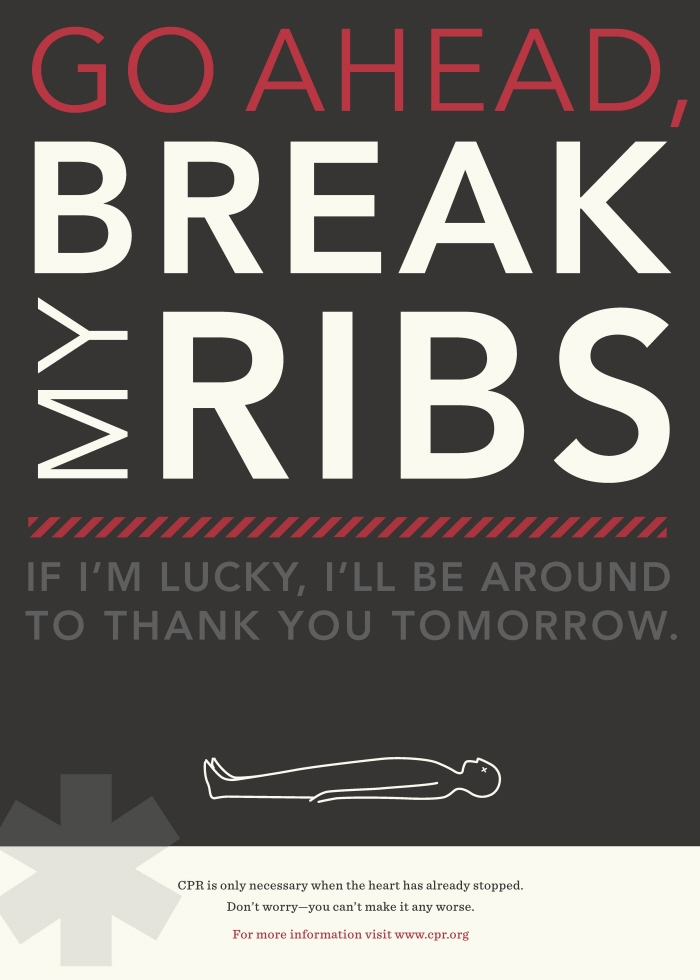
I want to talk about getting your community involved in CPR Programs and CPR education. Often I hear people, friend, family, acquaintances, bystanders talking about CPR, often I hear “I couldn’t do CPR I haven’t done a course”
Ambulance Computer aided dispatch has been providing CPR instruction over the phone for years, once a Cardiac or respiratory arrest is identified by information given by the caller a prompt is delivered to the call taker scripting providing CPR instruction to the caller, after establishing the ability of the person to perform CPR instruction is given for 100 beats per minute with no “rescue breaths”
CPR is an easy skill to provide a passing understanding of to the general public.
I can do the shopping centre version in under two minutes with a short practice.
1; Make a W start at the top and bottom of the sternum
2: Press at the…
View original post 192 more words
Rigid spine boards for immobilization. They knew it was garbage 15 years ago ! Hasnt changed http://t.co/K32PuJzHnt pic.twitter.com/CyuVZXXEz3
— Mike Abernethy (@FLTDOC1) January 9, 2015
Continue reading “EMS Management of Patients with Potential Spinal Injury”
An opportunity for a quick post to point to a new publication with something useful on drowning. From Dr Alan Garner.
Unfortunately we attend a number of paediatric drownings in the Sydney area every year. Many recover well. Some do not. Some do unexpectedly well. We have had a patient who was GCS 3 at our arrival and asystolic on the monitor make a full recovery. Most children in this situation however either die or are severely impaired.
This brings us to a vital question – when is it reasonable to stop resuscitation? Well, here’s some evidence to help inform the chat.
The Dutch Study
Over at the BMJ a new paper has just hit the screen:
This study is a nationwide observational study in the Netherlands of children with cardiac arrest…
View original post 148 more words
Well what are you waiting for? Come say hi at SMACC Chicago!





 Prehospital and Retrieval Medicine - THE PHARM dedicated to the memory of Dr John Hinds
You must be logged in to post a comment.